Skip to content
Looking for the Best concrete flatwork contractors services in Roundup MT? Get reliable pours, finish options, and smart hiring tips for local property owners.
A cracked driveway or sinking patio takes the shine off any property. Around Roundup, the rough Montana weather wears down poor concrete fast. Freeze-thaw cycles, snow piles, and clay-heavy soil punish anything that wasn’t poured right. That’s why so many homeowners and ranchers in Musselshell County look for crews who actually understand local ground conditions before pouring a single yard of mix.
At Artistic decorative concrete Inc, we’ve seen what works and what fails across central Montana, from driveways near the Bull Mountains to barn slabs out toward Lavina. If you’re hunting for the Best concrete flatwork contractors services in Roundup MT, you want a crew that pours flat, finishes clean, and stands behind the job. This guide walks you through the options, the real process, the cost drivers, and how to spot a contractor worth hiring. By the end, you’ll know what questions to ask before signing anything.
What concrete flatwork covers and why Roundup property owners need it
Flatwork is any concrete poured horizontally on the ground. So we’re talking driveways, sidewalks, patios, garage floors, shop slabs, and approaches. It also covers steps, equipment pads, and grain bin foundations common around Roundup ranches.
Why does it matter so much here? Montana sees serious freeze-thaw activity. According to the American Concrete Institute (2023), proper air-entrained concrete can survive over 300 freeze-thaw cycles, while standard mix often fails within 50. That single detail separates a slab that lasts 30 years from one that cracks in three winters.
The Best concrete flatwork contractors services in Roundup MT know how to spec the right mix for our climate. Mix design, base prep, and joint placement all matter just as much as how clean the finish looks on day one. Skipping any one of those steps shows up later as cracks, scaling, or settling.
Have you noticed flaking or pitting on an older slab in your yard? That’s almost always a sign of bad air content or premature freezing during curing. Newer pours done right won’t have that problem.
Types of concrete flatwork finishes and slab options
Every project around Roundup has its own demands. A horse barn slab handles different stress than a backyard patio. So the finish, thickness, and reinforcement should match the use.
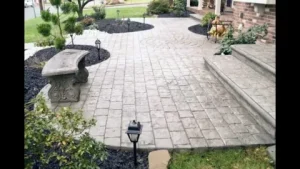
Broom finish is the workhorse choice for driveways and walkways. It gives traction in icy weather, which matters from November through March. Stamped concrete mimics stone or brick for patios and entryways. Exposed aggregate shows off pebble textures for a rugged look. Polished and stained finishes work well for indoor floors in shops and finished basements.
Here’s how the main flatwork options compare for typical Montana projects:
| Finish Type | Best For | Slip Resistance | Maintenance | Lifespan |
| Broom Finish | Driveways, sidewalks | High | Low | 30+ years |
| Stamped Concrete | Patios, entryways | Medium | Medium | 25–30 years |
| Exposed Aggregate | Walkways, pool decks | High | Low | 30+ years |
| Polished/Stained | Shop floors, basements | Low | Very Low | 40+ years |
Thickness also matters. A residential driveway needs at least 4 inches with rebar or wire mesh, while a shop slab for heavy equipment usually needs 6 inches with #4 rebar on 12-inch centers. Skipping reinforcement to save money is a classic mistake that shows up within five winters.
The concrete pour process from prep to cure
A solid pour follows a strict order. When any step gets rushed, problems show up later. So how does a real crew handle a project from start to finish?
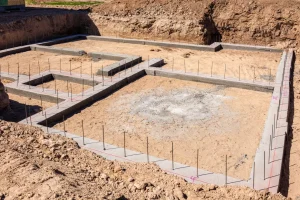
Site prep comes first. Crews remove sod, dig down to firm subgrade, and haul in road base or crushed gravel. The base is compacted in layers using a plate compactor or roller. Roundup soils often include expansive clay, which means deeper prep work and sometimes a geotextile fabric to keep things stable.
Forms go in next. Wood or metal forms set the edges, slope, and depth. A good crew checks for proper drainage away from buildings, which prevents water from pooling against foundations. Rebar or wire mesh sits on chairs about 2 inches above the base, never on the dirt.
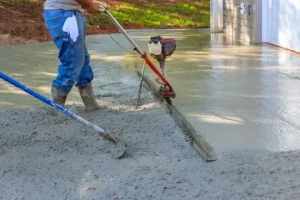
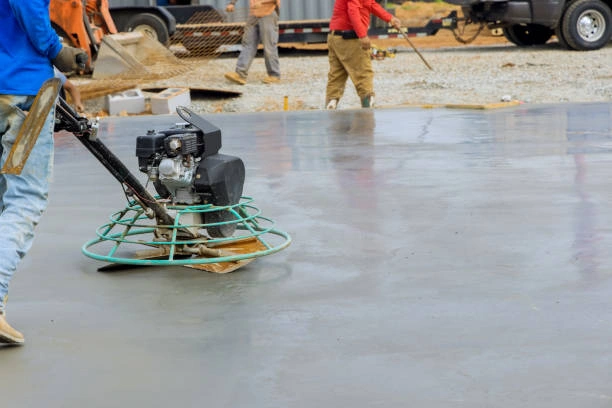
Then the pour happens. Trucks deliver ready-mix from local plants, often out of Billings or Lewistown. Crews place the mix, screed it level, and float it before finishing with brooms, stamps, or trowels. Control joints get cut within 24 hours to direct future cracks where you want them.
Curing is the final step and the one most contractors short-change. Concrete needs moisture for at least seven days to hit full strength. Curing compounds, wet burlap, or plastic sheeting all work. Steve Holloway, a licensed concrete contractor in Yellowstone County, sums it up: “Strong concrete isn’t about the finish. It’s about what happens in the first week after the pour.”
What affects concrete flatwork pricing in Roundup
Many things shape your final quote on a flatwork project. Reading bids carefully helps you compare apples to apples. When you look at quotes for Reliable concrete flat work Services in Roundup MT, focus on what’s actually included rather than just the bottom line.
Site conditions and access
The biggest variable is what’s already on the ground. A flat, open lot pours fast. A site with tree roots, old concrete to remove, or poor soil takes far more labor. Trucks need clear access too. Long pump distances or pour points blocked by buildings add equipment costs.
Soil quality matters as much as anything. Roundup sits on clay-rich ground in many spots, which expands and contracts with moisture. Crews sometimes need to dig deeper and add extra gravel base, especially near older homes built on settled fill.
Concrete mix and reinforcement
Alterations in mix design are done according to the project. For most residential flatwork the standard is 3,500 PSI, while shop slabs and approaches require 4,000 and 4,500 PSI. Any surface placed outdoors in Montana must have air-entrainment, as air bubbles allow freezing water a place to expand without cracking the slab.
The selection of reinforcement influences cost as well. Using fiber mesh in the concrete mix controls shrinkage cracks at lower cost. Rebar adds genuine structural strength for heavy use. In cold regions, properly reinforced and air-entrained slabs last about twice as long as similarly placed unreinforced pours (Portland Cement Association 2022).
Local companies that offer Reliable concrete flat work Services in Roundup MT such as Artistic decorative concrete Inc know which mix and prep depth suits which project type. With local know-how, there are less surprises and more accurate bids from the get-go.
Licenses also play in. Most flatwork in Musselshell County does not require a permit so long as it stays on private property and does not tie in to the public right-of-way. A permit is required through the Montana Department of Transportation or county road office for driveway approaches that meet county or state roads.
How to pick a concrete contractor in Roundup
Selecting a contractor is half the battle. The correct team completes flat work and it is on time. Moreover, we stand behind cracks/exclusions that are not hairline. The incorrect one vanishes after the verification clears. What are the things you should consider?
Begin with the fundamentals. Any contractor in Montana who works over $2,500 must register with the Department of Labor and Industry. Get request registration details and verify it online. Liability insurance and workers’ compensation are essential. If a contractor cannot show proof of both, walk away.
Examine the written proposal closely. A good concrete slab quote will provide slab thickness, PSI rating, type of reinforcement, joint spacing, finish, and curing method. A quotation which says a “concrete driveway” without any specifications is a red flag. Request a call to three local references from work performed in the local area of Roundup, Lavina, or Ryegate in the last 2 years.
A Roundup contractor that only does concrete flatwork, like Artistic decorative concrete Inc, will already know the local soil conditions, what mix to use for our freeze-thaw climate, and which insurance is particularly for the trade that general handymen usually miss. A concentrated work history is essential for handling challenging subgrade or weather conditions.
Communication is a huge clue as well When you call, a professional answers. You get a written bid in a couple of days. They explain each line. If they take a long time to respond in the bidding phase, it will only get worse once you pay a deposit.
We were told a story recently by a rancher near Roundup. He had three competitive quotes for a slab for 40′ x 60′ shop. The low price bid skipped on rebar and quoted only 4 inches thick. He successfully passed and opted for the medium bid with 6 inch reinforced concrete. Five winters later, his slab still looks good while his neighbors bargain pour has visible cracks across the bay doors.
Choosing the Right concrete flatwork contractors services in Roundup MT is all about verifying credentials, reading the bid specs closely, and trusting how the contractor communicates from Day One.
FAQ’s
How long does it take for concrete flatwork to cure in Roundup, MT?
Concrete acquires walkable strength within a span of 24 to 48 hours but must undergo moist curing for at least 7 days for strength development. A complete healing requires four weeks. Cold weather in Roundup can slow this, so crews often use blankets or insulation during fall and spring pours.
Is a permit necessary for a new driveway in Roundup, MT?
The location determines permits. You usually do not need a permit for a driveway fully on private property. However, a new approach connected to a county road or state highway will require approval through the local road office or Montana DOT. Before getting a start on any approach work, always check with Musselshell County.
What should the concrete driveway thickness be in Roundup?
The thickness of residential driveways that is properly compacted should be at least 100 mm. Driveways that carry heavy truck, RV, or farm equipment need 5 to 6 inches of concrete with rebar. It saves money at the time of construction but leads to cracking and settling within few winters.
What causes differences in concrete flatwork pricing in Roundup?
The price depends on mix quality, reinforcement, slab thickness, and base preparation depth. Less expensive prices often omit rebar or use thinner pours and short cure the slab. Bids with a higher price often incorporate PSI mix, air-entrainment. Always check specifications one by one, not just the total quote.
What concrete finishes last longest in Montana winters?
Broom finished and exposed aggregate slabs do best during Montana’s freeze-thaw cycles since they shed water well and provide good traction. To prevent scaling, you need to seal stamped finishes yearly. After finishing, air-entrained concrete can last for decades with a proper cream of cure, regardless of finish, even after Roundup harsh winters.
Conclusion
Good concrete flatwork is an investment that pays back quietly for years, even decades. If poured correctly, a slab can withstand Montana’s winters, heavy traffic, and ground shifting. Always review the contractor’s licensing, closely examine the bid specifications and ask questions about the mix design, reinforcements and curing. When it’s time to proceed, contact Artistic decorative concrete Inc for a free on-location assessment and clear responses to your questions regarding the project. When the start is right, the slab will lay flat and strong long after the truck leaves.
Concrete acquires walkable strength within a span of 24 to 48 hours but must undergo moist curing for at least 7 days for strength development. A complete healing requires four weeks. Cold weather in Roundup can slow this, so crews often use blankets or insulation during fall and spring pours.
The location determines permits. You usually do not need a permit for a driveway fully on private property. However, a new approach connected to a county road or state highway will require approval through the local road office or Montana DOT. Before getting a start on any approach work, always check with Musselshell County.
The price depends on mix quality, reinforcement, slab thickness, and base preparation depth. Less expensive prices often omit rebar or use thinner pours and short cure the slab. Bids with a higher price often incorporate PSI mix, air-entrainment. Always check specifications one by one, not just the total quote.
The price depends on mix quality, reinforcement, slab thickness, and base preparation depth. Less expensive prices often omit rebar or use thinner pours and short cure the slab. Bids with a higher price often incorporate PSI mix, air-entrainment. Always check specifications one by one, not just the total quote.
Broom finished and exposed aggregate slabs do best during Montana’s freeze-thaw cycles since they shed water well and provide good traction. To prevent scaling, you need to seal stamped finishes yearly. After finishing, air-entrained concrete can last for decades with a proper cream of cure, regardless of finish, even after Roundup harsh winters.